Where to Propose in Rome: The Places That Actually Work
23 September 2026/7 min read
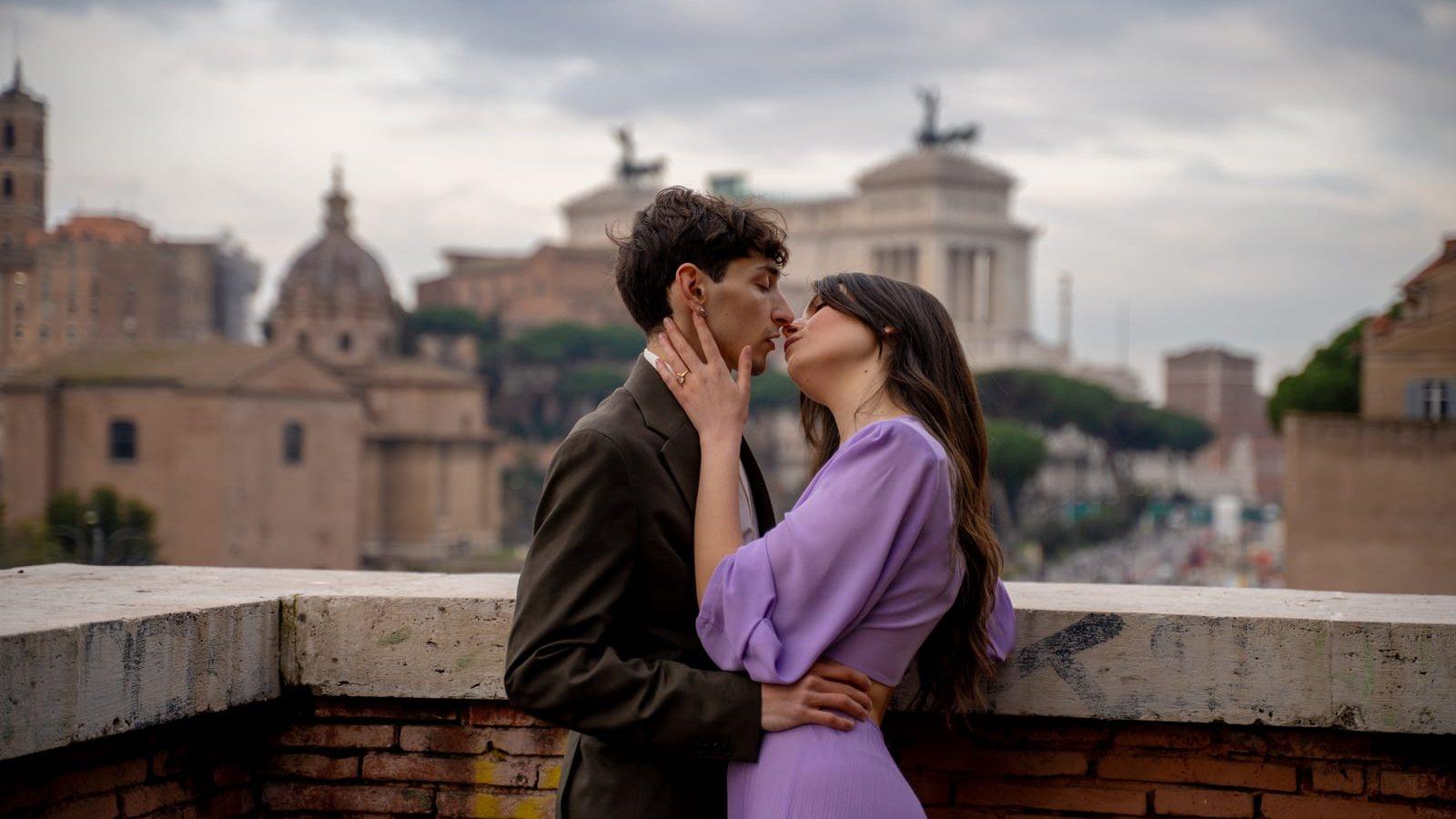
The famous five, and why most of them fail
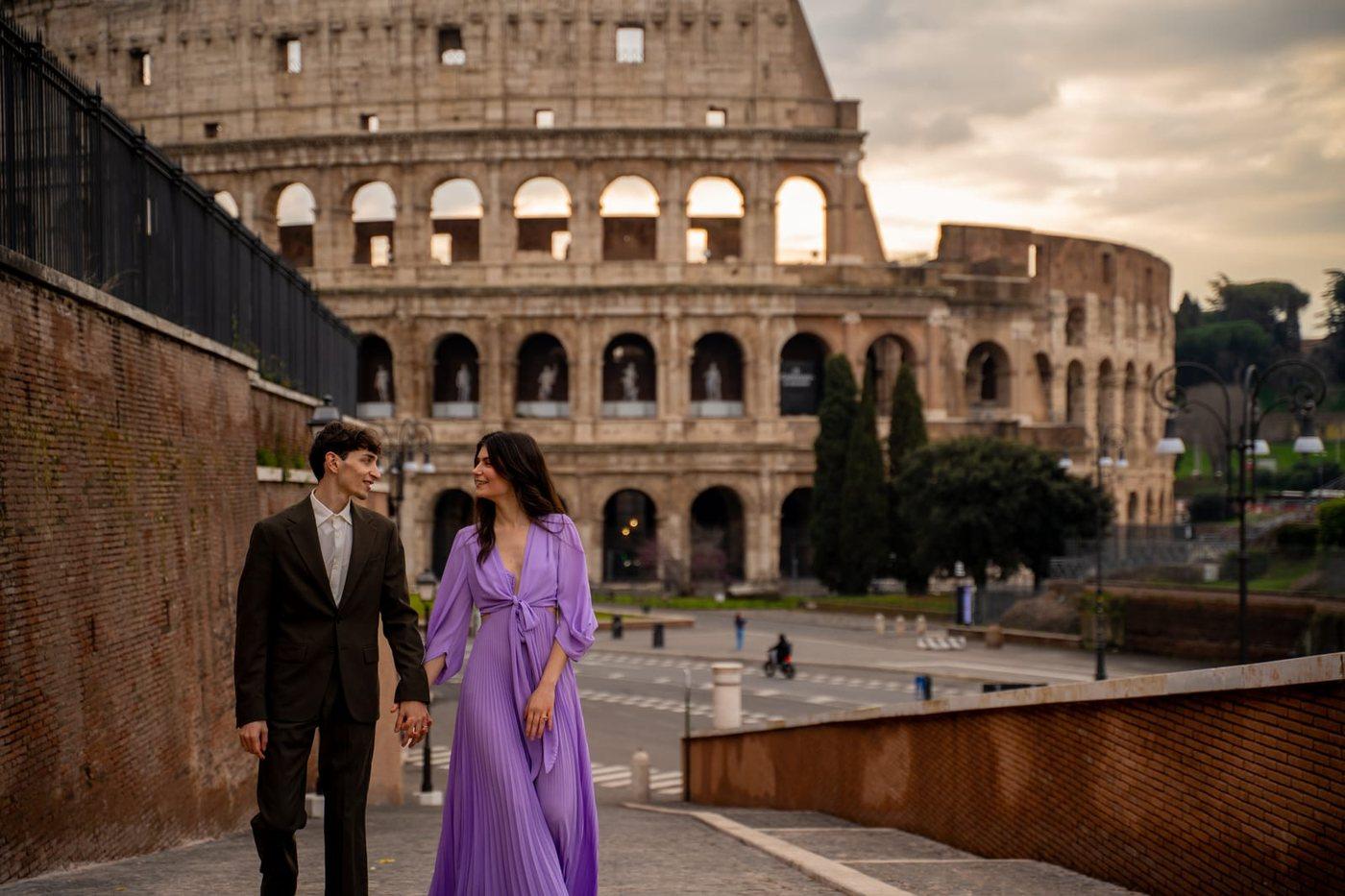
Every guide to proposing in Rome names the same places. The Trevi Fountain. The Spanish Steps. The Colosseum. St Peter's Square. A terrace somewhere above the rooftops, unnamed.
They are not wrong about the beauty. They are wrong about the hour, and the hour is what decides whether you get a photograph of two people or a photograph of two people surrounded by four hundred strangers holding phones.
The Trevi Fountain in the middle of the day is a scrum. It is loud enough that a quiet sentence will not carry. The Spanish Steps have a rule against sitting on them and an officer whose job is enforcing it. St Peter's Square is vast in a way that swallows two people entirely, and the Colosseum has a road and a queue between you and the view of it.
None of this makes them impossible. It makes them a matter of timing and position rather than of choice, which is a different kind of planning and mostly happens before dawn.
What follows is where the proposals we produce in Rome actually happen.
Terraces above the Tiber
The quietest category in Rome is the private terrace, and it barely appears in any guide because you cannot book one.
Above the river and across the older quarters there are rooftops attached to residences, small hotels and private apartments, most of them invisible from the street and none of them listed anywhere. They hold four people or forty. They look across to the domes, and in the last hour of light the whole city in front of you turns the colour of the stone it is built from.
These are arranged directly, one at a time, by people who know the owner. That is the entire mechanism. There is no platform, no form, and no price list, which is why they stay quiet and why they remain the strongest option in the city for a proposal that should not be witnessed by strangers.
The Aventine, early
The Aventine Hill carries three things within a few hundred metres of each other: the orange garden with its view across the river, the basilica courtyard, and the keyhole in the priory door through which St Peter's dome sits framed at the end of a hedge-lined path.
By ten in the morning there is a queue at the keyhole. By seven there is nobody at all, the light is coming in low and sideways, and the garden is empty except for residents walking dogs.
The hill rewards arriving before the city does. It is also compact enough that a route can move through all three points in half an hour, which gives a photographer more than one composition without anybody having to get into a car.
Looking down into the Forum
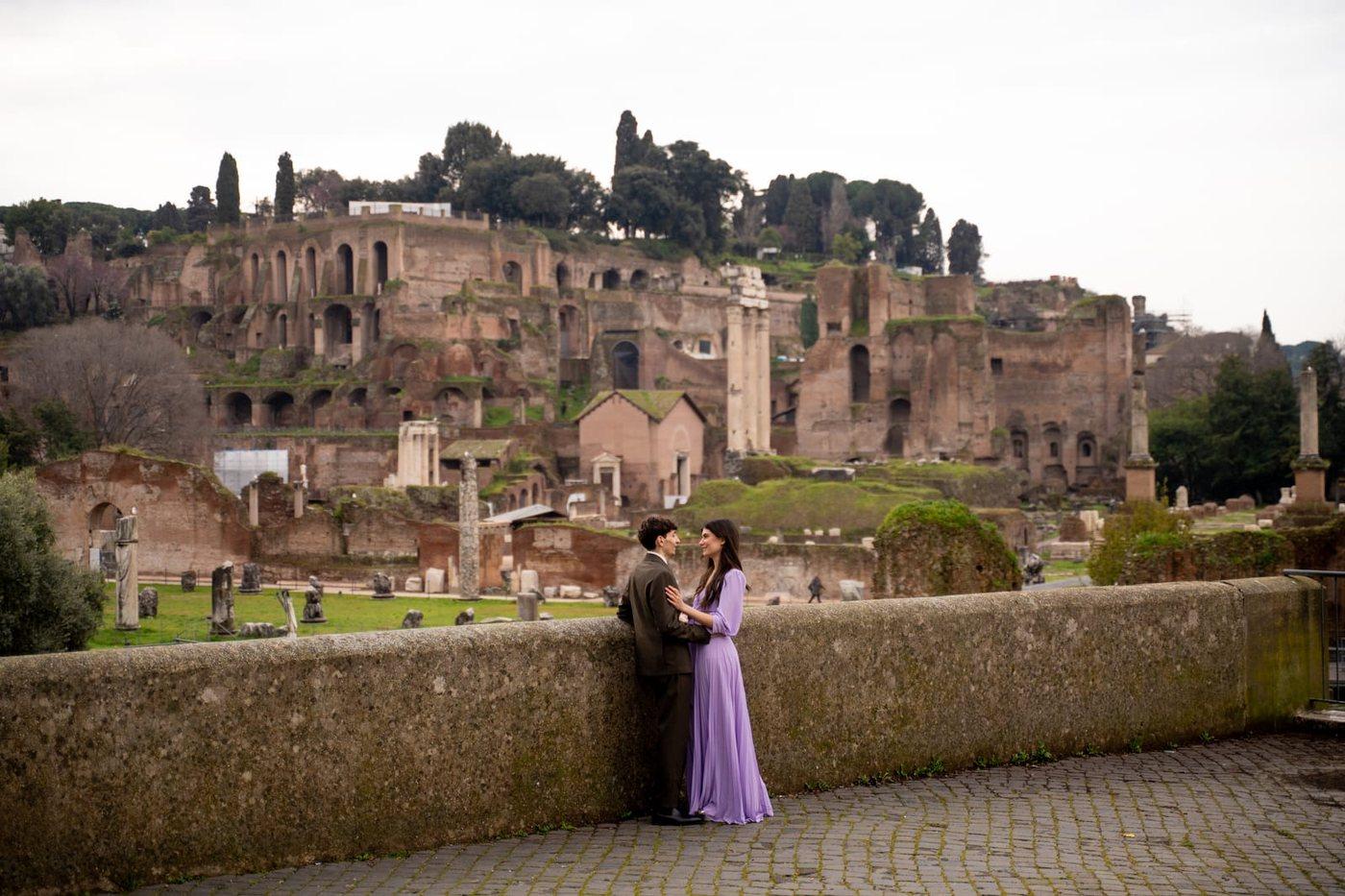
There is a difference between being in the Roman Forum and being above it.
Inside, it is a ticketed archaeological site with a set path and a lot of people on it. From the terraces and walls that overlook it, the whole thing opens out below you: columns, arches, the Palatine rising behind, and almost nobody standing where you are.
This is where a proposal in Rome can be unmistakably Roman without being a tourist photograph. The ruins do the work in the background while the two people in front stay the subject. It is also one of the few places in the centre where the view is free, unticketed and available at any hour, which matters more than it sounds when you are timing a day to the minute.
Trastevere and Monti, after the light goes
Not every proposal wants a view. Some want a street.
Trastevere and Monti are the two quarters where Rome stops being monumental and becomes domestic. Narrow lanes, ivy, shuttered windows, a piazza with four tables outside a bar and somebody's laundry three floors up. After dark they are lit by doorways and street lamps rather than by floodlights, which is a warmer and far more forgiving light than anything pointed at a monument.
They suit a couple who would find a terrace with a view slightly formal. The photography is different too: closer, less landscape and more portrait, with the city as texture instead of backdrop.
The practical caution is noise and footfall. Both quarters are busy in the evening, and busy in a way that is charming to walk through and difficult to propose in. The solution is a specific corner at a specific hour, scouted rather than wandered into, and usually a courtyard or a doorway a few metres off the main run.
What a landmark proposal actually takes
If your heart is set on one of the famous places, it can be done properly. It just costs the early alarm.
The sequence is always the same. The photographer is in position first, usually twenty minutes ahead, reading as one more person taking pictures of a building. You arrive on foot from an agreed direction so the approach itself is usable footage. There is a signal, settled in advance and small enough to do without looking like you are doing anything. And there is a second position ready in case somebody has parked a van in the first one, which in Rome happens more often than anyone plans for.
None of that is complicated. All of it has to be decided before the morning, because at the moment itself you should be thinking about one thing only, and it is not where the photographer is standing.
The hour is the part people underestimate. A landmark at seven in the morning and the same landmark at noon are not the same place, and the difference is not marginal. One of them is a private stage and the other is a public square with several hundred people in it.
Gardens that close before the light arrives
A warning that catches people out.
Several of the gardens most often recommended for a Rome proposal close at or before sunset for much of the year. The guide that recommended them was written from a photograph rather than from a visit, and the gate is shut at exactly the hour the photograph was taken.
We check opening hours against sunset for the specific date, every time, because the answer changes through the year and because a locked gate at the top of a hill is not a problem you can solve at the time. Where a garden does close early, the answer is usually a terrace that does not.
The river, and the bridges nobody photographs
Rome's river is underused for proposals, largely because the postcard bridges are the wrong ones.
Ponte Sant'Angelo is beautiful and permanently occupied. But the Tiber runs for kilometres through the centre, and the embankments either side of the famous stretch are almost empty at any hour. The water is low and green, the plane trees lean over the walls, and the bridges further out have the dome in the distance rather than directly overhead, which is a better composition and a much quieter one.
Tiber Island is the exception worth knowing. Reached by a bridge at each end, small enough to walk around in ten minutes, with steps down to the water and a view back at the city that most visitors never bother with. Early or late it is close to deserted.
There is also a practical advantage to the river. It is linear. A route along an embankment gives a photographer a predictable path and several usable backgrounds without anyone having to cross a road or wait for a gate, and it works in weather that would close a garden.
A room the city does not advertise
Occasionally a proposal calls for an interior. A courtyard in a historic residence, a library, a room in a palazzo that is not open to the public and is not trying to be.
These exist in numbers that surprise people, and they are approached one at a time, in Italian, usually through somebody who has worked with the household before. They cannot be searched for and they are not bookable. When a concept needs one, the work is finding whether a room of that character can be opened on that date, rather than choosing from a list.
It is the same approach we take to proposal planning across Italy, and in Rome it is the difference between a proposal that looks like the city and one that looks like a version of the city nobody else has seen.
So which one
The honest answer is that the place is the last decision, not the first.
Someone who would be mortified by an audience should not be proposed to at a landmark, however beautiful, and someone who wants the city itself in the photograph should not be taken to a private room with the shutters half closed. The setting follows the person. That is why our first conversation is about the two of you rather than about locations, and why the concepts we send afterwards tend to surprise people who arrived certain they wanted the Trevi Fountain.
If you are still working out what she would actually want rather than what looks best in a photograph, start there. The rest of it, we can arrange.
You can see how a full day in the city is built in our approach to proposals in Rome, and what the same thinking looks like on water in Venice.
Questions we are asked
- Can you propose at the Trevi Fountain?
- Yes, but the hour decides everything. In the middle of the day the piazza is crowded and loud enough that a quiet sentence will not carry. Early morning, before the city wakes, it is a different place entirely, and a photographer can work from the outer edge without anyone else in the frame.
- Where is the most private place to propose in Rome?
- A private terrace. Above the river and the older quarters there are rooftops attached to residences, small hotels and apartments that are invisible from the street and listed nowhere. They are arranged directly with the owner rather than booked, which is why they stay quiet.
- What time of day suits a proposal in Rome?
- Either the hour before the city wakes or the last hour of light. Before nine the landmarks are empty and the light comes in low and sideways. In the evening the stone turns gold and the city softens. The middle of the day works for almost nothing.
- Do you need a permit to propose in Rome?
- For a proposal between two people with a discreet photographer, generally not. Formal setups, professional equipment, private access to a garden or a closed venue are a different matter and are arranged case by case. We handle whatever a given concept requires rather than leaving it to the day.
- Is the Aventine keyhole worth it for a proposal?
- Early, yes. By mid-morning there is a queue and the composition includes it. At seven there is nobody, and the hill also holds the orange garden and the basilica courtyard within a few hundred metres, so a route can move through several settings in half an hour.
Planning something like this
Tell us what you have in mind. The first conversation is complimentary and carries no commitment.
Request a private consultation